For venues
Put the line on the screen.
Winner stays on is already how your room runs. CueLibre makes the line visible, the results honest and the arguments disappear — one screen, the code on the table, and nothing for your staff to referee. When you want a bigger night, the same screen runs the tournament.
CueLibre charges venues, not players. Players play free, and we never touch the money that passes between players — not the pot, not a cut, not escrow.
Why one free table
Your busiest night is also the night the most people walk out.
Your week is earned in a few hours
A pool hall is busy for a handful of hours on a handful of nights. What the room takes in those hours carries the rest of the week, so every person in the building then matters.
And in those hours, people leave
Every table is taken and the list of people hoping for one runs long. Someone who looks in reads it correctly: no table tonight. They go, their group goes with them, and nobody counts them.
Take one table off the meter and give it to the room. Anyone can put a name on its free play list from their own phone. The winner stays on, the loser comes off and the next name is called. A game is short, so the list moves, and everyone on it gets to the table.
- The walk-in has a reason to stay. “No tables tonight” becomes “put your name on the free one.”
- The people waiting are in your room. A place on a list that moves is a reason to find a seat for the next hour, not to stand in the doorway deciding where else to go.
- The room has a table to watch. A rented table is private. This one has a line of challengers and a name that has held it for six racks, on a screen the bar can read.
- Your other tables rent as they do today. Nothing about them changes: not the rate, not the hours, not who takes the money.
Rental buys the table. Free play buys a turn.
Nobody holds the free table by paying for it or by staying on it. They hold it by winning, and nobody wins all night. Anyone who wants a table to themselves for the evening still rents one, and some of them decide that after a rack on the free one.
Who it brings in
The group that would have left
Every table was taken, so they were on their way somewhere else. Now they are on a list, and they can see it moving.
The one who wants a few shots
Not an hour and not a group, just one rack. No meter runs. They lose, they come off, and nothing is owed.
The one who likes the lights
Better than half the room and would like it known. A table people watch, a name on the screen, a streak to hold.
The pair
Doubles run on the same list. They bring a partner or find one in the line.
The one who came to watch
Never picks up a cue. Follows the table from a bar stool for the whole evening.
Choose the table the bar can see
The free table works by being watched. Give it the table with the clearest view from the bar, not the one in the back that rents least, and put the screen where the bar can read it.
Two of these are people you do not serve today: the group that leaves, and the player who will not rent a table for an hour. Renting is a decision. Putting a name on a list is not, which is why it reaches them.
The running room
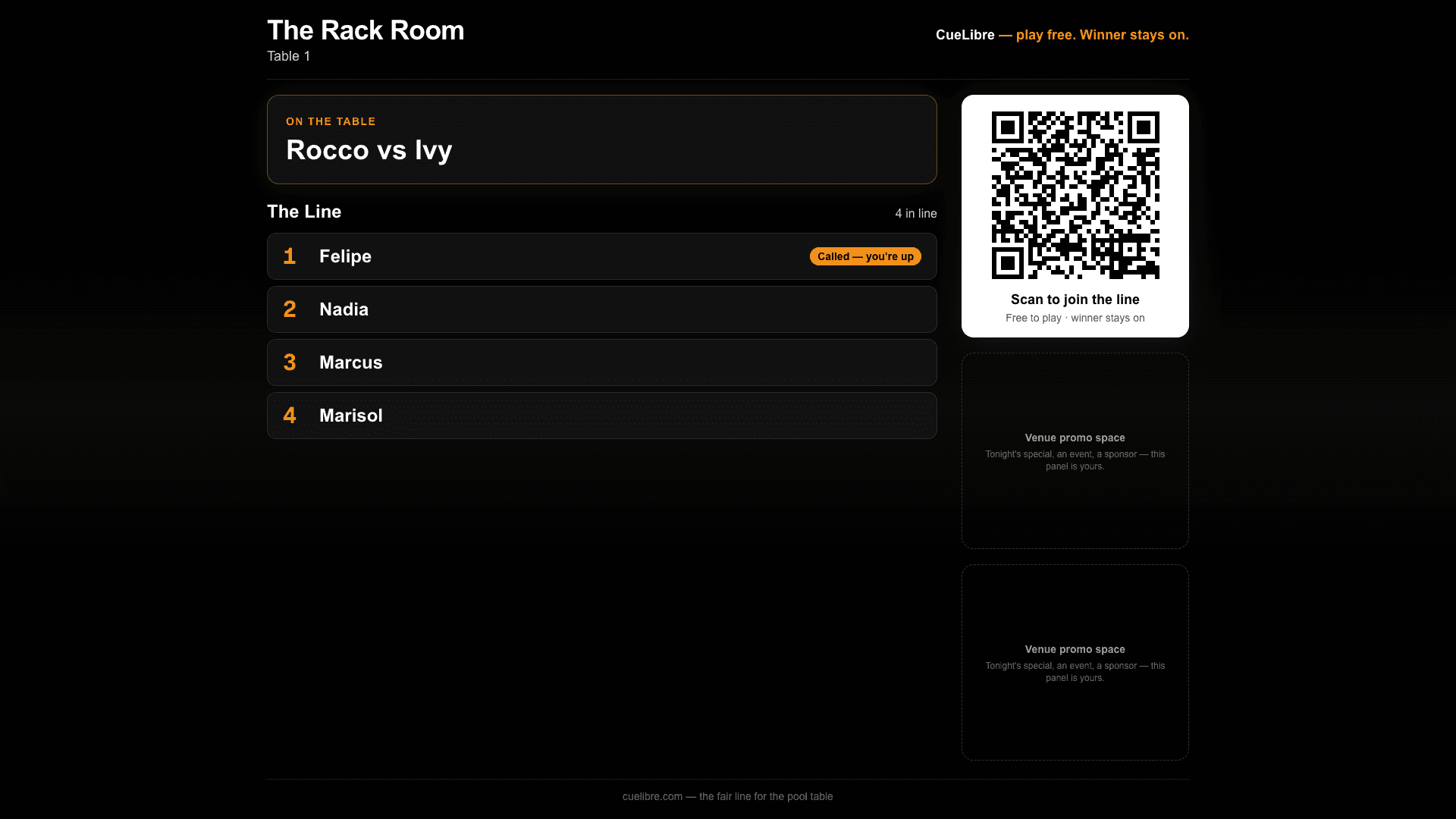
The line, on a screen the room can see
Players scan the code on the table, sign in on their own phone and take a place in the line. The screen shows the order. Nobody asks the bar who is next.
The same line, in every player’s hand
The page a player lands on after they scan shows their place as a big number and how many are ahead. Right under it is the line, in the order the screen shows it: who is on the table, who has been called, then everyone waiting, with their own row lit. It moves by itself. When they are called it says so, with a clock, and from the same page they can step away and keep their place, skip a turn, or leave. Nobody has to ask the bar where they stand.
Winner stays on, by itself
When a game ends the winner keeps the table, the loser comes off, and the next player is called — on the screen and by email. The result is confirmed by the players; a disagreement climbs a short ladder, with the next people in line as witnesses.
Stepping out, coming back
A player who needs a moment taps pause from their email and keeps their place for a few games; one who has left can decline their turn in one tap, and the line moves on.
Your hours, your rules
Set the days and hours the free line runs and how it closes for the night. A staff console behind your own PIN removes no-shows and, if it comes to it, keeps a player off the line.
The board between games
The screen rotates: the line, the two players at the table with their record against each other, tonight’s session between them, and the room’s own leaderboard — most wins and longest streak, tonight, this week, this month, all time. Your rules take the whole screen for half a minute every other round, and go to every player’s phone when they sign up.
Counts, never a clock
The screen and every player’s page show how many are ahead — a number that is always true. It never guesses a time, because a guessed time is the first thing a room stops trusting.
A stand by the register
A small stand for the counter or the ball return: a tap of a phone on it puts a walk-in on your free play list before they reach the table. Its face carries no code to photograph — a tap is the way in. Its well holds stickers your regulars take and hand on — each one becomes the taker’s own code, and whoever joins through it is theirs, and their Connection. You see taps, sign-ups and stickers taken, by stand, on your own page.
Tournament nights, on the same screen
Entries from their phones
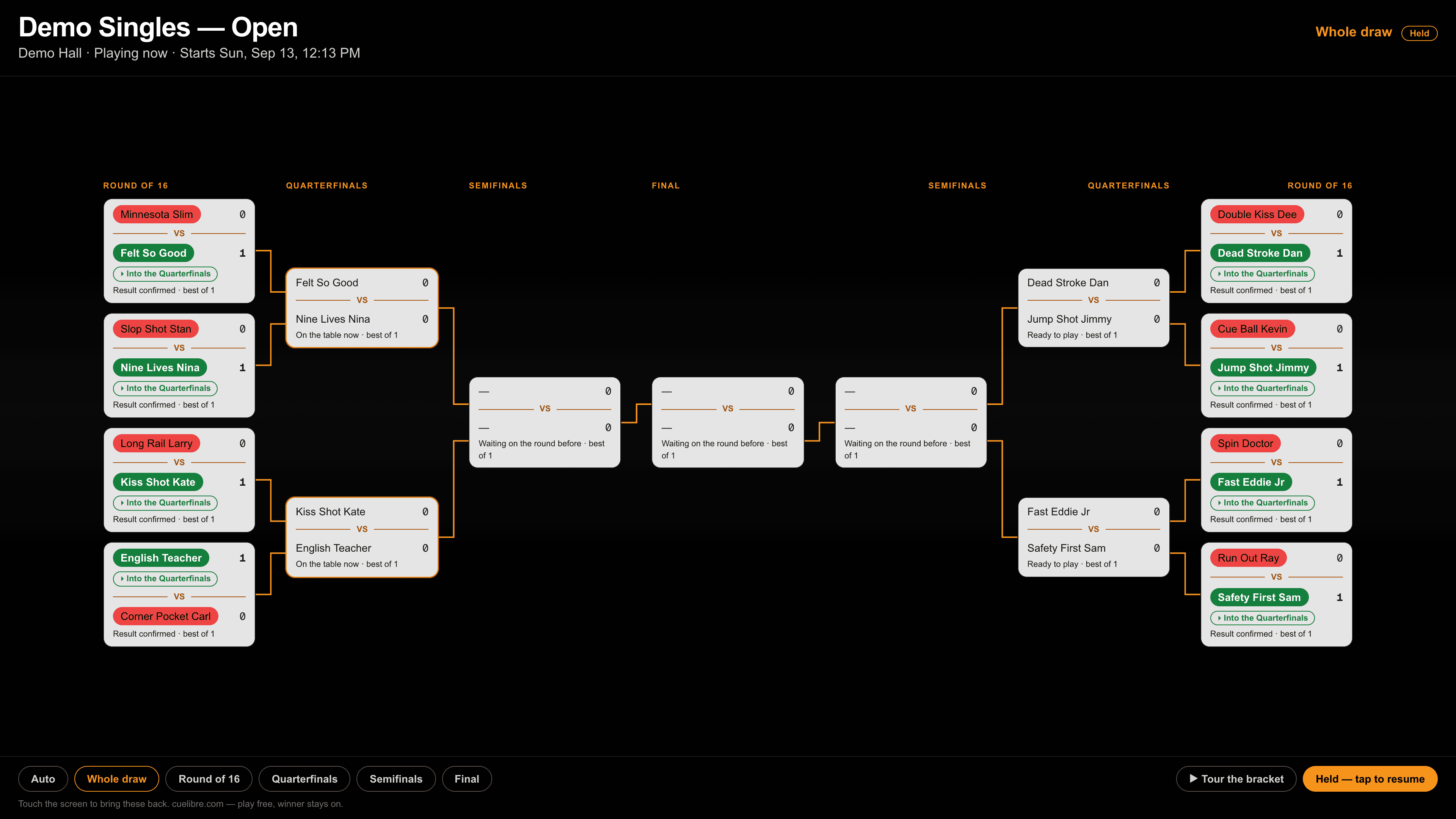
Open a tournament and players enter from the same phone they joined the line with, until the posted start. Singles, doubles or teams; a straight knockout, groups into a knockout, or a race.
The draw on the wall
Seeded or random, best of one, three or five, across as many tables as you give it, with late entries and byes handled. The bracket goes up on the wall display; results are confirmed at the table; the standings are on their own page.
Prizes you declare
If you put up a prize, the screen shows what you declared for each place. You provide it and you award it. CueLibre shows it and never holds it.
The line is told
When a tournament takes a table, the people waiting on it are emailed that their spot was cleared, why, and that the line opens again when the tournament releases the table — and, in the last quarter of an hour before the start, that there is still time to enter.
What it never does
- Never guesses how long anyone will wait — counts only.
- Never shows a player’s email or phone to anyone, including you. Usernames only.
- Never lists your room as a CueLibre room until you claim it. An unclaimed listing only says the room exists and has tables.
- Never touches the money that passes between players. That is a design decision, not a roadmap item.
What trying it asks of you
You do not have to believe any of this. You can try it.
- To sign
- Nothing.
- For your staff to do
- Nothing while it runs. A console behind your own PIN is there for the rare no-show.
- Your rental rates
- Unchanged. Every other table rents as it does today.
- Your hours
- Yours. You set the days and hours the free line runs, and change them when you like. On a night too busy to spare the table, your staff stop the list: everyone on it is told at once, their places are kept for twelve hours, and when you restart it the same list carries on where it stopped.
Where to start
- Start with one busy night. Free one table from the start of the rush to close, one night a week. The people it is for are already standing in your room, so nobody has to be brought in. A month gives you four nights to set against the four before.
- Then every busy night. If the four nights were worth it, run it whenever the room is full. If they were not, stop.
If it goes wrong
“My renters will play free instead.”
They get one rack at a time with a line behind them. A group that wants a table for the evening still rents one. If it bothers you, narrow the hours.
“It will fill with people who buy nothing.”
Your rules are on the screen and go to every player’s phone when they sign up. What those rules say is your decision.
“There will be arguments over who won.”
Both players confirm the result on their own phones, and a disagreement goes to the next people in line as witnesses. Your staff are not the referee.
“Nobody will use it.”
Then we take the screen down.
You can stop on any day and be no worse off than the day before you started.
How you will know
Before the month starts, write down what the bar took in those hours over the last four weeks. Afterwards, compare. CueLibre can tell you how many people joined the list and how many games were played. Only your till can tell you whether it paid, and we will not guess at that for you.
What we ask: fifteen minutes
One screen, one table, one month, nothing to sign. We bring the screen on a slow shift, set it beside a table and leave it running. If your regulars don’t love it, we take it down. Ask for the visit and a human answers.
The founding offer, in shape
Every room keeps its page and its history free, for good, with a free play list of up to eight people and a bracket of up to eight. A bigger list or bracket is a plan the room pays for, paid ahead, with nothing charged automatically. A room that stops paying keeps its page, its history and its free list, and carries on where it left off when it pays again.
The first rooms to run CueLibre are founding rooms, and the offer to them has four parts. The figure is not on this page — it comes with the visit, once we have seen your room. The second and third parts are terms of the founding agreement, which the owner puts in writing after the visit. No room has one yet.
- A Founding price. The first rooms start on a Founding price.
- A founding-room discount on support, maintenance and management that stays with the room while it is with us.
- Founders’ rates on sponsor commissions. When CueLibre brings a sponsor to your screen, a founding room keeps more of what its own screen earns.
- Gear and services for your players, with a commission to your room. Through Pastime Exchange: cues, cases and bags, cue holders, chalk and tips, gloves, training tools, balls and racks, table care — and tables, re-felting, re-levelling, moves, cushion replacement and lessons. Ordered online, or from a display case in your room if you want one. A commission to your room, paid by Pastime Exchange, on the orders your room sends there — through your room’s link or your display case — once they are fulfilled. The terms come with your founding agreement.
Read how the line works from a player’s side on the FAQ, or see the room’s own pages at venues.